Fire Risk, Then and Now in 32nd Street Canyon
Those who lived in and near the canyon in the early aughts have stories of encampments, gangs guns and fire -- one blaze big enough to summon municipal helicopters. The drainages were then choked with 4 acres of Giant Cane (Arundo donax). Just as worrisome were flammable mounds of One-Eyed Wattle (Acacia cyclops). The canyon was a long and dangerous wick. Twenty five years ago, removing six blocks of nonnative combustibles was a first order of business for the Friends of 32nd Street Canyon. Afterward, under the direction of restoration ecologies and the wildlife agencies, we planted fire-adapted native California species.
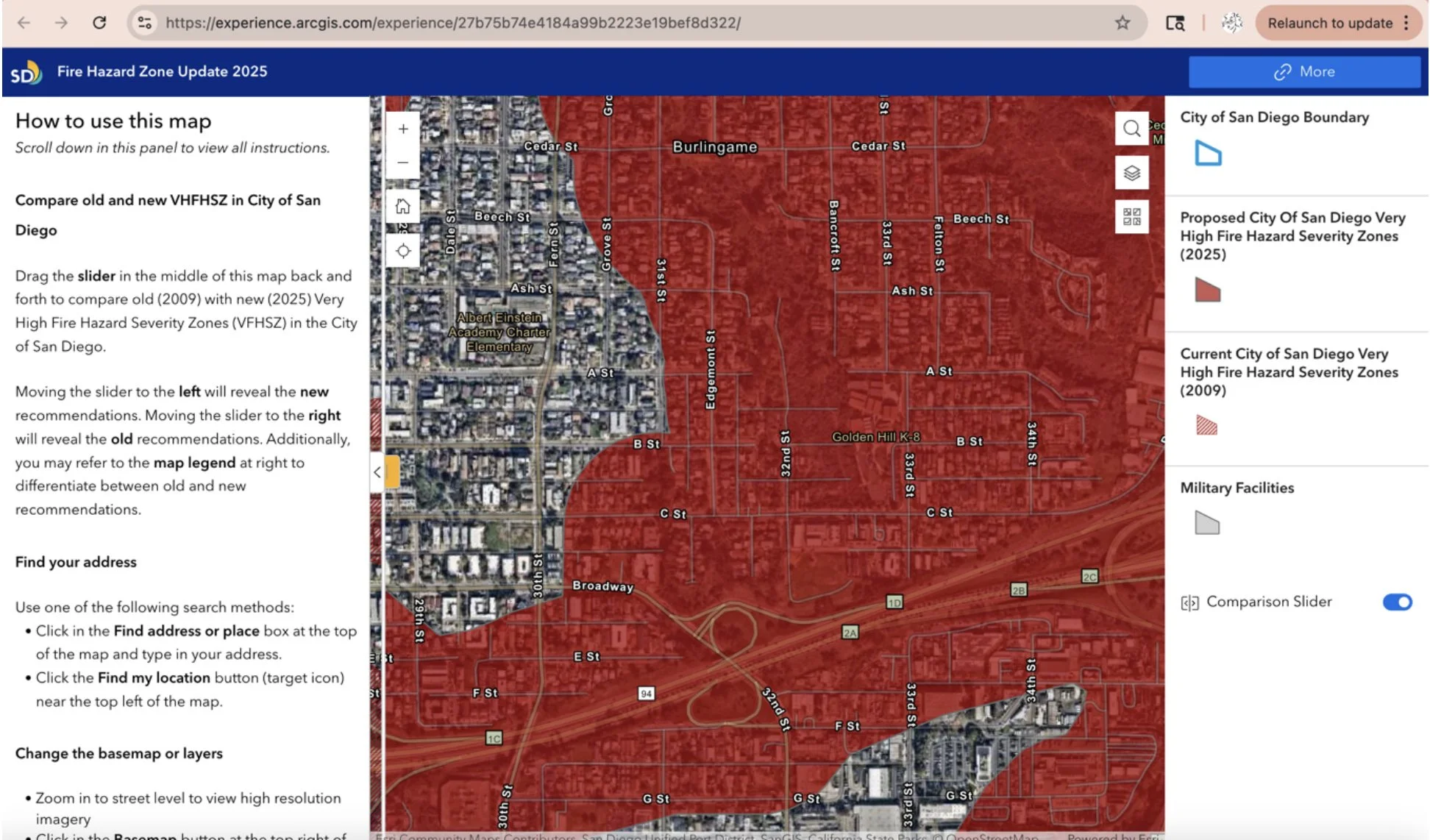
Time and human disregard have again given the flammable nonnatives an advantage here. A member of the 32nd Street Canyon Task Force, Susan Swisher has helped plan and seek partnerships for our “Swapping Fire Fuel for Habitat” initiative. In doing so she learned that eastern Greater Golden Hill – between 30th and Interstate 15 -- is a "Very High Fire Hazard Severity Zone." (See map.) With education in horticulture, Susan was suddenly spotting fire risks everywhere. Tightly-packed neighborhoods of mostly wooden houses are separated by steep-sloped canyons suffering from aridity. Fuel-heavy invasive nonnative plants and woody debris pose a risk wherever they are. So Susan went knocking on the Fire House door. These circumstances inspired a correspondence exchange with San Diego Fire and Rescue Department Fire Marshal Tony Tosca.
Susan carried a map of the Severity Zone under her arm when she set off for a meeting of Mid-City Fire Safe Council leaders in the fire-impacted College Area. There she met Assistant Fire Marshal Alex Kane, San Diego Fire and Rescue Department’s new wildfire program manager. Kane is adding smokejumper and GIS staff to the City’s response team. He listened to concerns and commended the Fire Safe Councils, which are under the State and County. Invasive plants are definitely in the crosshairs in dedicated open space. Surrounding private property owners and renters can benefit from affordable tips for upgrading their own property’s fire resistance. Susan realized that a formal fire-safe council could rally others around a shared vision of preparedness and partnership with city, county and other resources.
The conversation with Assistant Fire Marshal Kane emboldened Susan Swisher to enlist other fire-council members, create a logo, and to apply to the County for Fire-Safe-Council accreditation. Greater Golden Hill’s council went into effect just last week. For this, we have Susan Swisher to thank.